

You Got There. The Feeling Did Not.
Behind closed doors it is a different story. The targets are being hit. The boxes are being checked. Everything looks like it is working. And something is very wrong and there is no time to figure out what because there is already another one due.
There is a scene in I Love Lucy where Lucy is working a conveyor belt at a chocolate factory. The chocolates come down the line and she sorts them. Then they come faster. Then faster. She starts stuffing them in her mouth. Then her hat. Then her uniform. Desperately trying to keep up with a belt that never slows down.
Nobody watching thinks she is in crisis. They think it is funny.
That is what the inside of a fast-moving success cycle actually looks like. Not at the end. Not when the big goal is finally crossed. In the middle. While everything is still working. While the numbers are still moving. While every external signal says keep going.
The chocolates keep coming. The person on the line keeps finding new places to put them. And the belt never slows.
There is a man who called a friend at 6:47am on a Sunday. His business had crossed 4 million in revenue. He had not slept in four days. He was not at the end of anything. He was still inside it, still building, still hitting targets, still checking boxes. And he was thinking about driving his car into a wall.
4 million. On paper it was working. The belt was moving. And the person running it had reached the point where there was simply nowhere left to put the chocolates.
This is not a story about what happens when you finish something. It is a story about what happens when you keep going and the cycle keeps spinning and the pressure keeps building and nobody around you can see it because from the outside it still looks like momentum.
Before you keep reading, here is what this article covers:
Why the micro success loop spins faster with every completed task and what that costs
Why the pressure builds invisibly while the numbers still look fine
Why driven people are the most vulnerable to this pattern and why it accelerates the longer it runs
What is actually happening in the body when the belt is moving too fast to keep up with
The belt that never slows
Most conversations about achievement and emptiness talk about the big finish. The degree earned. The business sold. The project completed. The moment you finally cross the line you have been running toward.
But the crash does not wait for the grand finale.
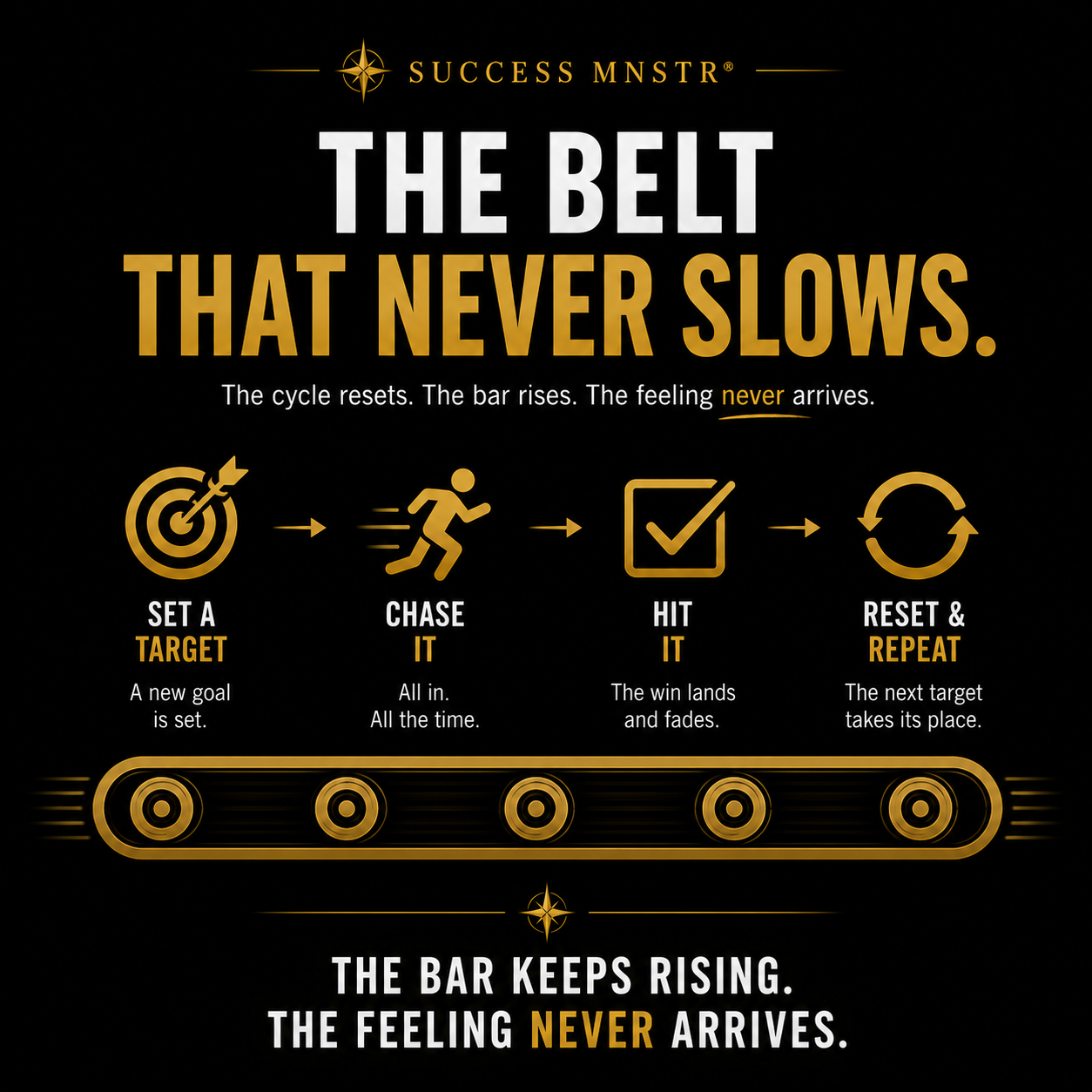
It builds in the micro cycle. The daily loop of tasks, targets, and checked boxes that makes up the inside of any significant pursuit. Set a target. Chase it. Hit it. Reset. Set the next one. The loop spins. And with every completed task, every checked box, every small win that disappears the moment it arrives, the system learns one more time that the solution to the discomfort of an empty box is to fill it.
So the list gets longer. The pace increases. The gap between finishing one thing and starting the next shortens until there is no gap at all. Not because the person is disorganized or undisciplined. Because the system running the cycle has been trained to treat the gap as a problem to be solved.
Why does hitting a milestone feel like nothing? Why am I not satisfied even after achieving my goals? Why does every win feel smaller than the last? These questions come from people who are still inside the cycle, not people who have finished it. Still building. Still striving. Still hitting targets that should feel like progress and landing flat every time.
The person asking these questions is not at the end of the conveyor belt. They are standing on the line while it accelerates.
This is the Reward Evaluation System in the brain constantly recalibrating what success should feel like. Every target crossed updates the baseline. What felt significant six months ago barely registers now. The system raises the bar automatically, which means the person running the loop never actually arrives anywhere. They just keep hitting new versions of the same starting line.
"I was a prisoner to the doctrine of more. More money, more success, more targets, more boxes." That came from someone who had been inside this cycle long enough to recognize it from the outside. The doctrine of more is not a character trait. It is what the Reward Evaluation System generates when every milestone is immediately replaced with the next one, teaching the brain that the current level is never enough and the next level will be the one that finally delivers the feeling that the current one did not.
The feeling never arrives. The belt just moves faster.
What the body is carrying while the numbers look fine
Here is what nobody watching the conveyor belt sees.
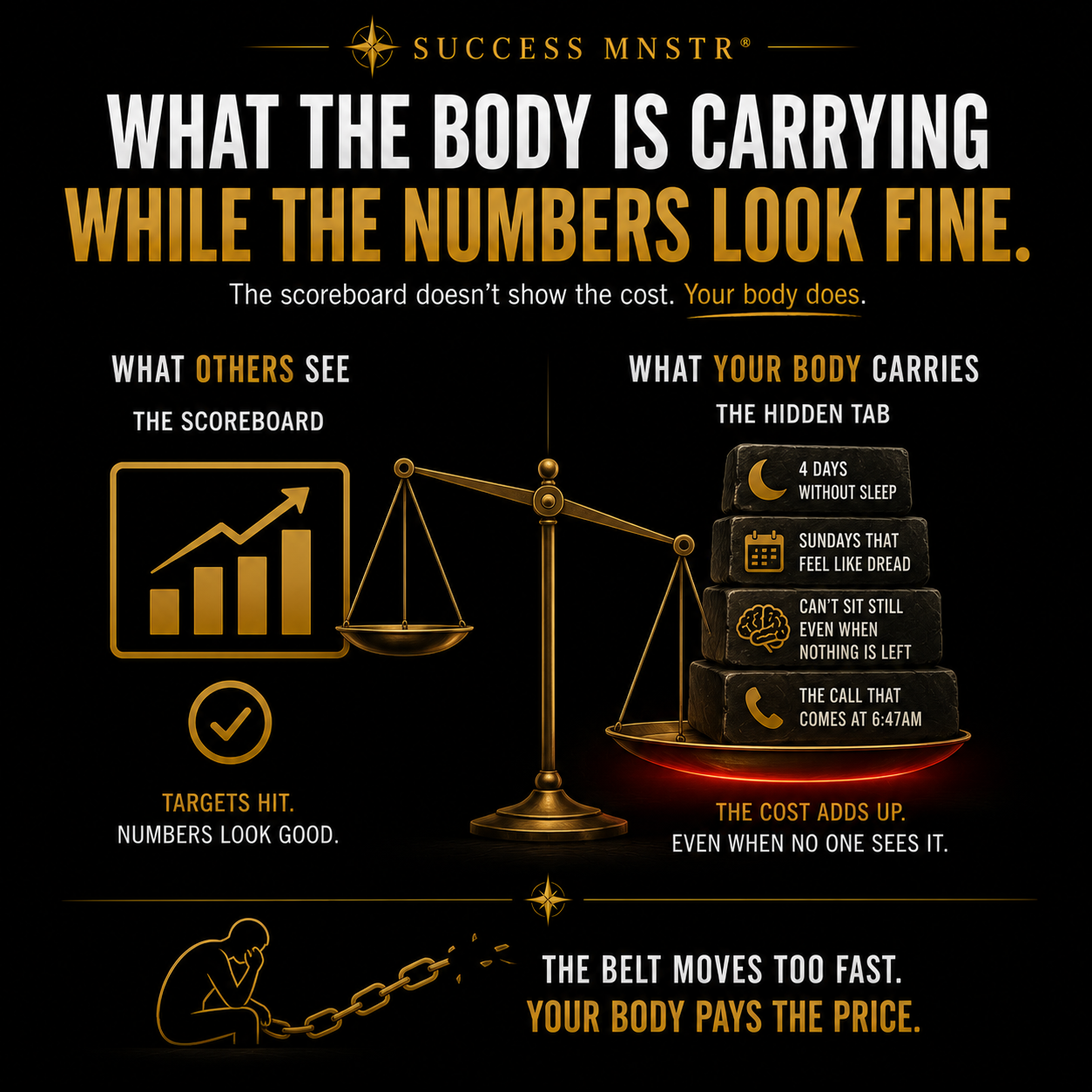
The body keeps running the tab even when the scoreboard says everything is fine. Every target hit and immediately replaced adds to a cost that does not show up in the numbers. It shows up in the four days without sleep. In the Sunday that feels like dread instead of rest. In the inability to sit still even when there is nothing left to do. In the call that comes at 6:47am. Neuroscientist Bruce McEwen named it allostatic load: the accumulated biological cost of sustained stress and adaptation. It is not tiredness. It is the measurable, cumulative biological wear of running the system at high capacity for a sustained period without a real landing between cycles.
The person hitting targets every week for twelve months is not carrying the cost of one project. They are carrying the compounded cost of every micro cycle that ran without a real reset. And that cost accumulates quietly until the system cannot carry it quietly anymore.
The man who made that call was not failing. He was at the point where the accumulated cost of every milestone hit and immediately replaced had exceeded what the system could carry. The belt had been moving too fast for too long. And the system was telling him the only way it knew how.
For the full biology of how this accumulation works including the brain engines, the chemistry, and what happens in the body when sustained pursuit runs without recovery, read Why Success Feels Empty: The Brain Science Behind the Crash. This article is about what that accumulation feels like from the inside while you are still in the middle of it.
The advice everyone gives you is adding more chocolates not slowing the belt
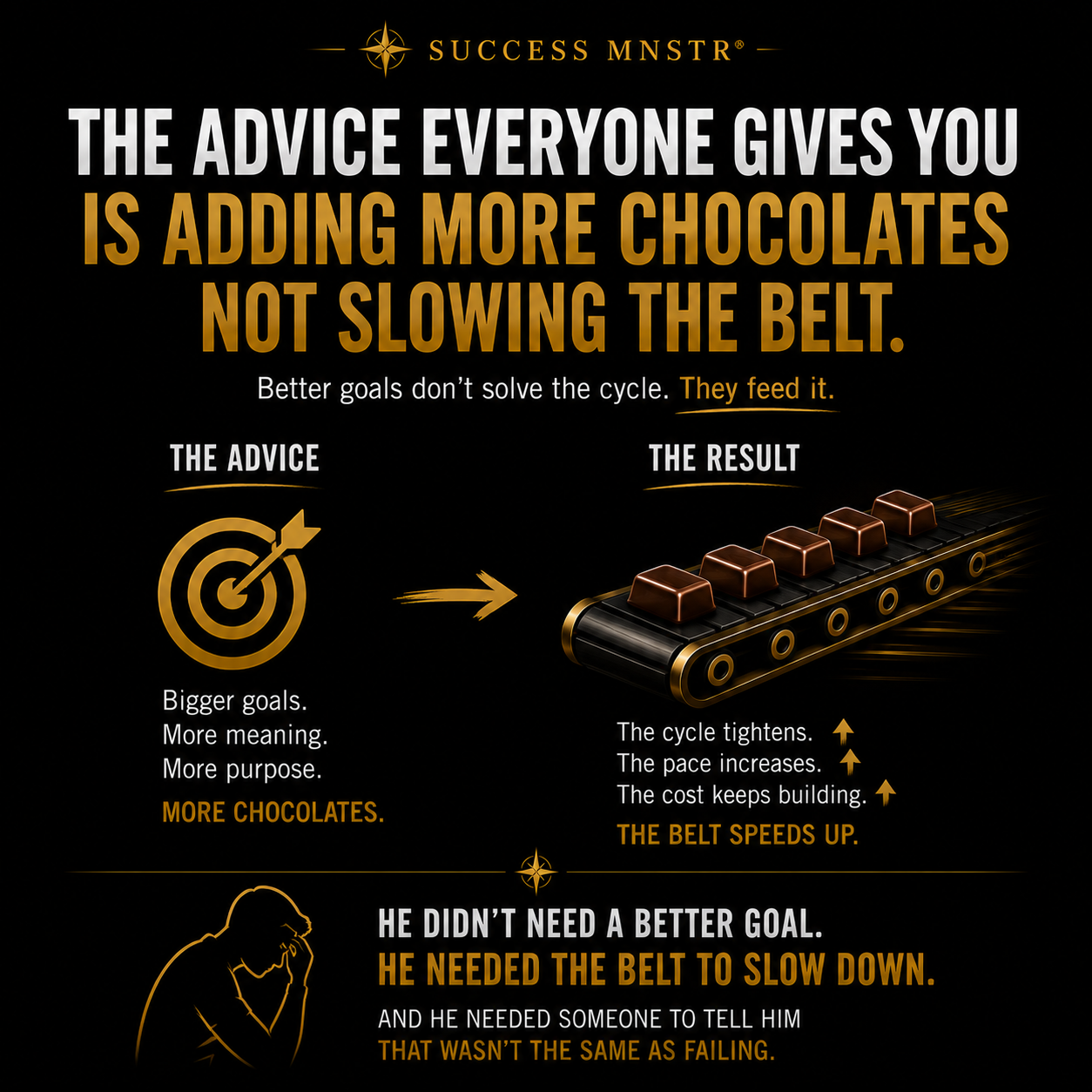
When someone describes the hollow feeling of hitting milestone after milestone and feeling nothing, the advice is almost always the same. Find more meaning in the work. Set bigger goals. Build a more purposeful mission. The idea being that if the targets were more meaningful the wins would land differently.
That advice does not slow the belt. It adds more chocolates to it.
Every time the system is told that the solution to hollow success is a better goal, the cycle tightens. The targets get bigger. The pace increases. The gap between hitting something and chasing the next thing gets shorter. And the accumulated cost keeps building toward the moment when the system can no longer carry it quietly.
The man on the phone did not need a better funnel or a more meaningful mission. He needed the belt to slow down. And he needed someone to tell him that was not the same thing as failing.
If you want to understand why the system generates resistance the moment you try to slow it down, Why Driven People Can't Stop Even When They Want To covers exactly that. And if you want to understand why the finish line keeps moving no matter how many milestones you hit, Why the Goal You Chose Is Not Actually Yours covers that too.
What the gap between milestones is actually for
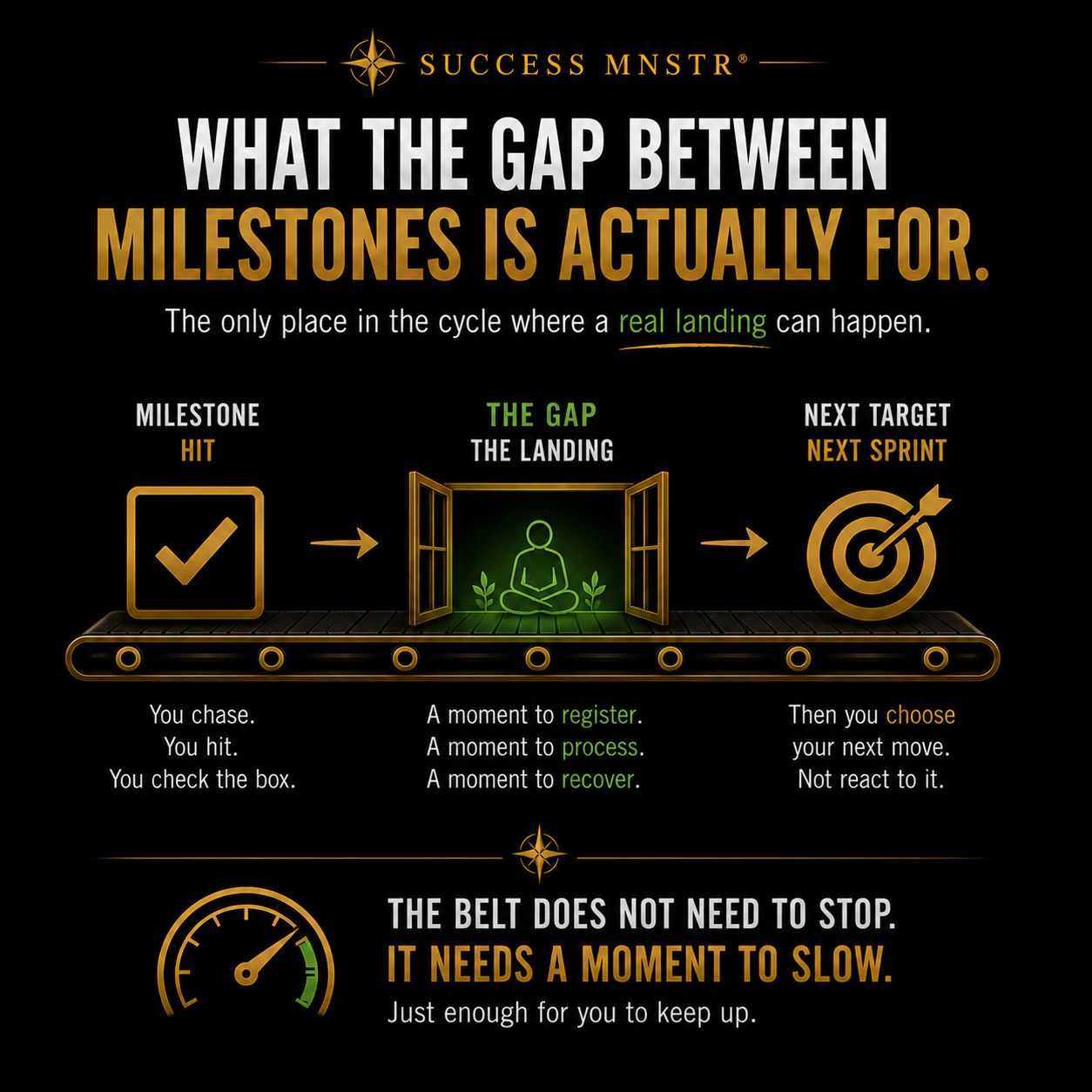
There is a moment between every checked box and the next unchecked one. A brief window where the pursuit chemistry drops and something in the system could, if given the chance, register what just happened and process what it cost.
Most people close it before it opens fully. Another target. Another sprint. The cost carries forward.
That gap is not wasted time. It is the only place in the cycle where a real landing can happen. Where a milestone can register as real rather than just another box crossed off a list that never ends. Where the system can process a fraction of what it has been carrying before the next sprint begins.
The belt does not need to stop. It needs a moment to slow. Just enough for the person running it to keep up without stuffing things in their mouth, their hat, or places they will absolutely regret later.
If you made it to the bottom of this article, something in it landed. Maybe you recognized the belt. Maybe you recognized the call. Maybe you are the one who has not slept. Whatever brought you here, you do not have to figure out the next step right now.
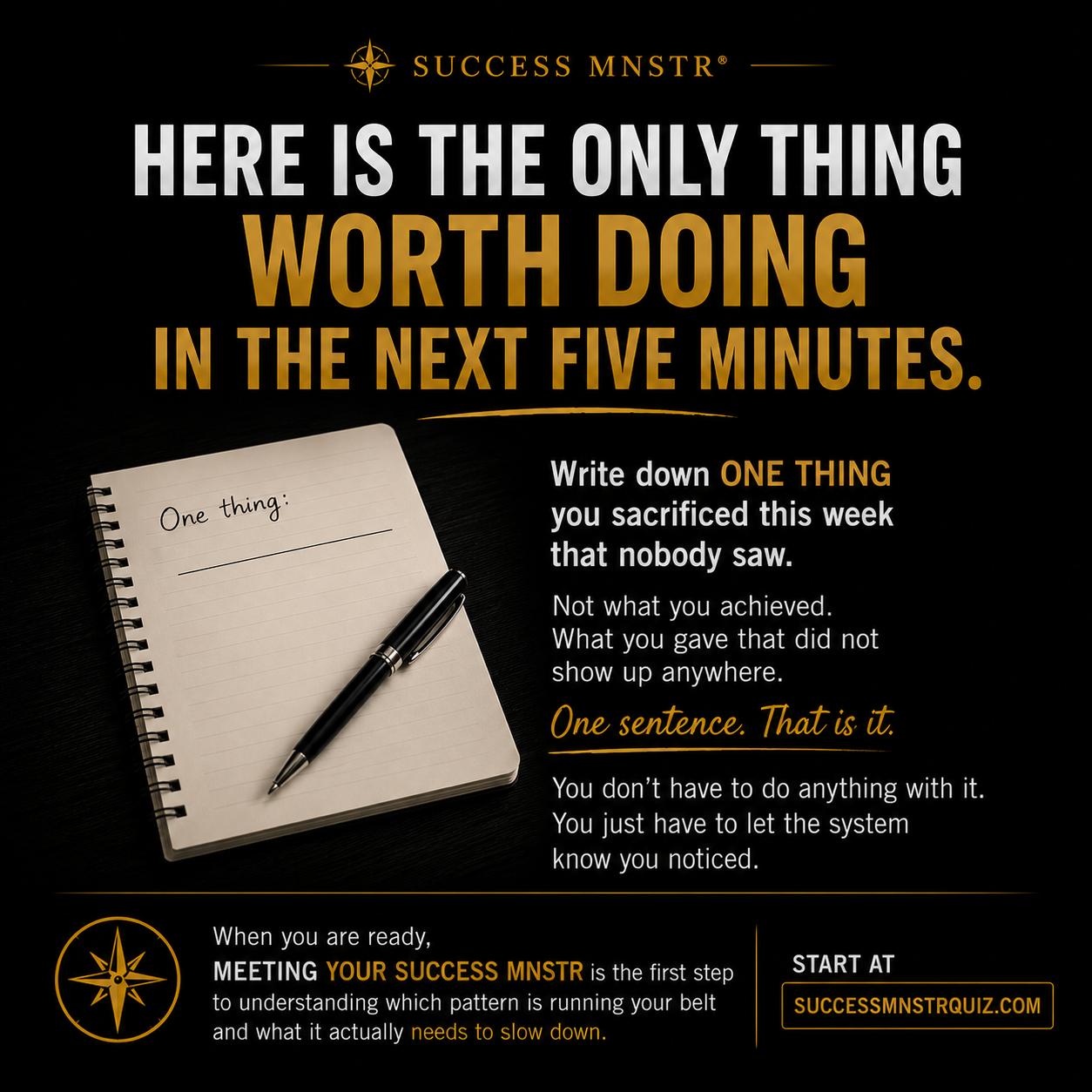
Here is the only thing worth doing in the next five minutes.
Write down one thing you sacrificed this week that nobody saw. Not what you achieved. What you gave that did not show up anywhere. The dinner you were physically at but mentally absent from. The sleep you traded for one more hour of work. The person who needed you and got the version of you that was already somewhere else. One sentence. That is it. You do not have to do anything with it. You just have to let the system know you noticed.
When you are ready, meeting your Success MNSTR is the first step to understanding which pattern is running your belt and what it actually needs to slow down. Start at SuccessMNSTRquiz.com