
Why Success Feels Empty: The Brain Science Behind the Crash
The world teaches you how to chase. Nobody teaches you what to do when you finally finish.
You finish something significant. A launch. A degree. A season. A decade of work. And instead of the feeling everyone told you was coming, you get flatness. Restlessness. That hollow question nobody warned you about: is this it? Why don't I feel happy after reaching my goal? Why does success feel empty when everything on paper says it should not? What is this blue feeling after achievement that nobody mentioned?
Most people reach for the same explanation. Ungrateful. Not ambitious enough. Wrong goal. So they set another one, keep moving, and wait for the feeling to arrive at the next finish line.
The finish line was never the problem. What nobody explained is what your brain does the moment the chase ends. And what follows has a name. Several of them, actually. Post-achievement depression. Post-success blues. The post-success downer. The arrival fallacy. Researchers and clinicians have been documenting it for decades. What nobody built was a system for what to do in the middle of it.
If you have ever finished something meaningful and felt worse instead of better, this article is for you.
Before you read further, here is what you will understand by the end:
Why the crash after a big finish is biological, not personal, and why that distinction changes everything
Why the standard advice to set a new goal is the single fastest way to make the next crash worse
What allostatic load is, why it accumulates with every cycle you run, and why rest alone does not fix it
What the arrival fallacy actually is at the neurological level, not just the psychological one
Why the window of disorientation after a big finish is the most important biological moment most people waste
What Post-Success Psychology™ is and why understanding it is the beginning of breaking the cycle
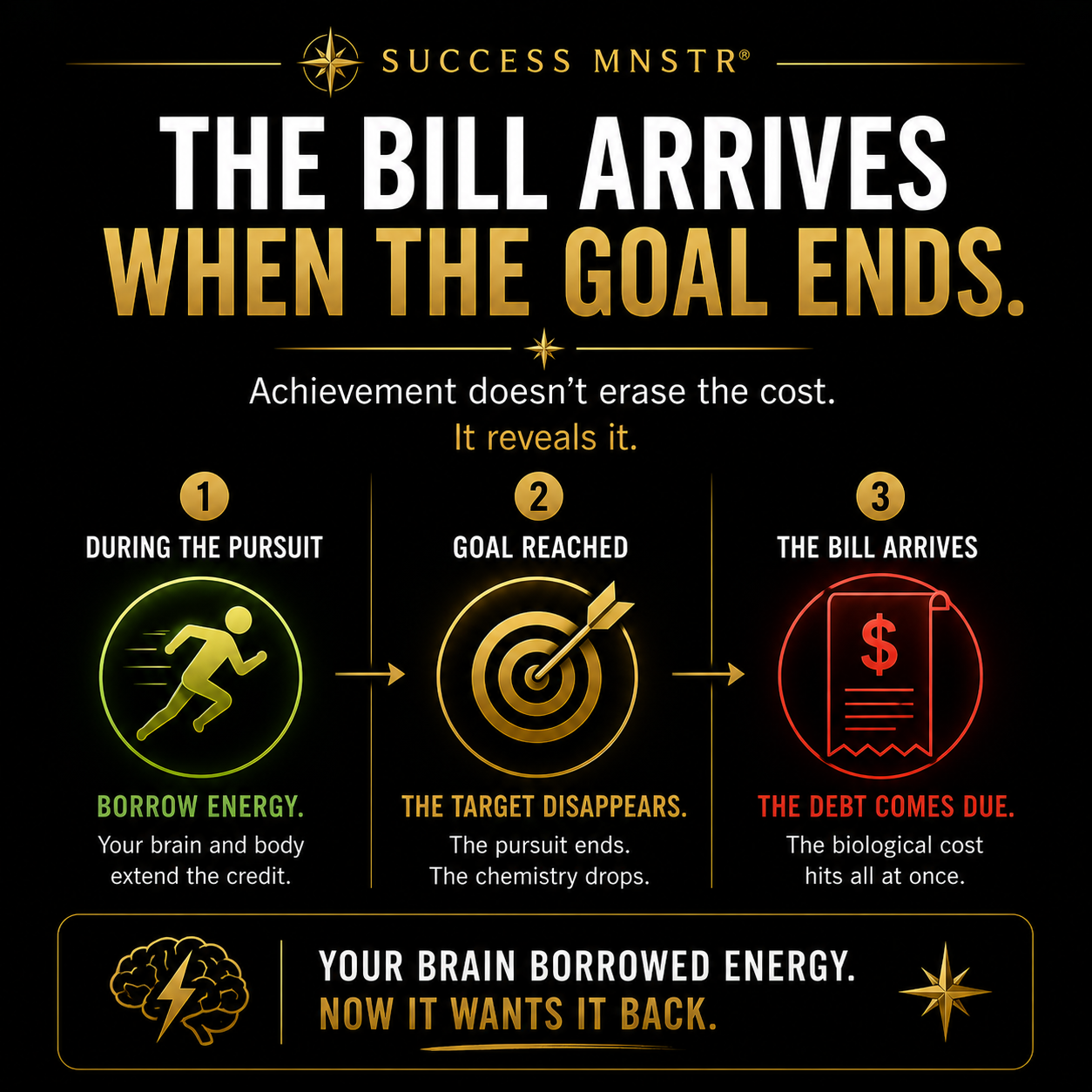
The biological bill arrives exactly when the goal ends
What most people call burnout after a big win is often something more specific. Neuroscientist Bruce McEwen and physician Eliot Stellar named it in 1993: allostatic load. The measurable, cumulative biological cost that accumulates in the body during sustained periods of stress, vigilance, and adaptation.
Every time you push toward a goal, you are borrowing energy from your future self to use right now. The brain and body extend that credit willingly during the pursuit because the target justifies the cost. But the debt does not disappear when the goal is reached. It waits. And the moment the pursuit ends and the chemistry drops, the bill arrives all at once. That is why driven people who accomplish significant things can feel physically wrecked the moment they stop, even when nothing in their life is technically wrong. The debt just came due.
This is also why so many people who finish something significant describe feeling depressed after achieving long-term goals they genuinely wanted. The emotional flatness is not ingratitude. The physical exhaustion is not weakness. Both are the biological cost of the pursuit arriving at the exact moment the reason for the pursuit is gone.
Think of it like this. You borrowed energy from your future self to fund the chase. The bill is not due while you are running. The moment you stop, you have to pay your debt. And rest alone does not clear it. You cannot sleep off allostatic load. The accumulated biological cost has to be processed, not avoided. People who keep busy after a big finish and people who take a weekend off often feel equally terrible two weeks later. Neither approach addresses what the body is actually carrying.
I am not saying rest is wrong. I am saying rest alone, without understanding what the body is processing, is like taking a nap on a flight when what you actually need is to land.
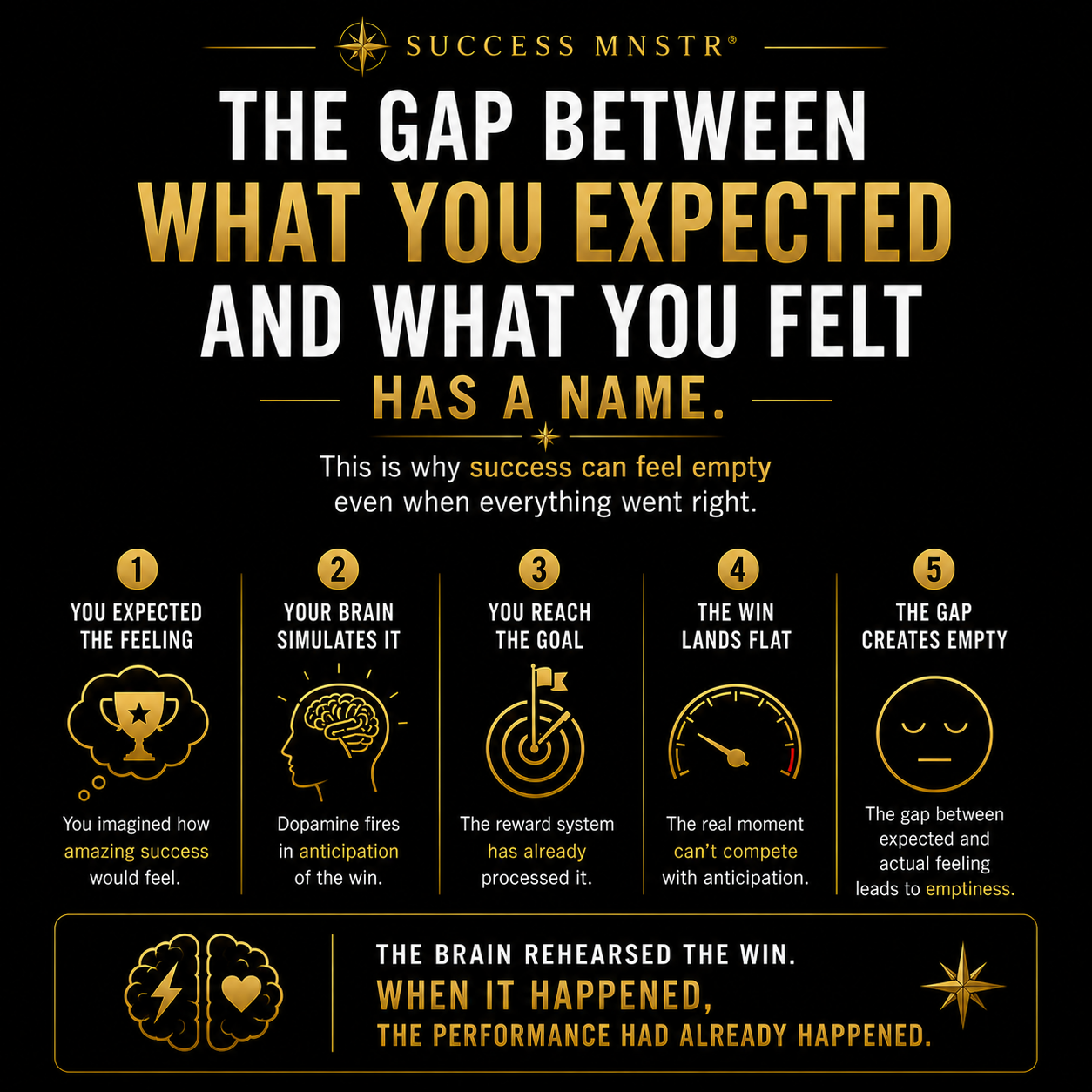
The gap between what you expected and what you felt has a name
Harvard psychologist Tal Ben-Shahar named it the arrival fallacy: the gap between what you anticipated feeling when you crossed the finish line and what you actually felt when you got there. It sits at the center of why success feels empty even when everything went right, and it is one of the most searched and least answered questions in post-success psychology.
The arrival fallacy runs deeper than disappointment. It is a specific neurological event. During the pursuit, the brain anchors its reward system to the imagined feeling of completion. Dopamine fires in anticipation of that feeling, not in response to it. By the time you arrive, the reward system has already partially processed the win in advance. So the actual moment of completion lands flat, or does not land at all.
The fact that the brain simulates the win during pursuit means the actual experience of finishing could never compete with the anticipation of it. That is how the reward system was built. And understanding that changes what you look for at the finish line.
People who accomplish remarkable things can feel, when they finally stop moving, like they have nothing to show for it internally. They feel empty after achieving something they worked hard for. The win did not land. The brain had been rehearsing it for months, and when the real moment arrived, the performance had already happened. What gets labeled post-achievement depression or post-success blues is often this exact mechanism: the dopamine already spent, the serotonin not yet activated, the body carrying a debt nobody named.
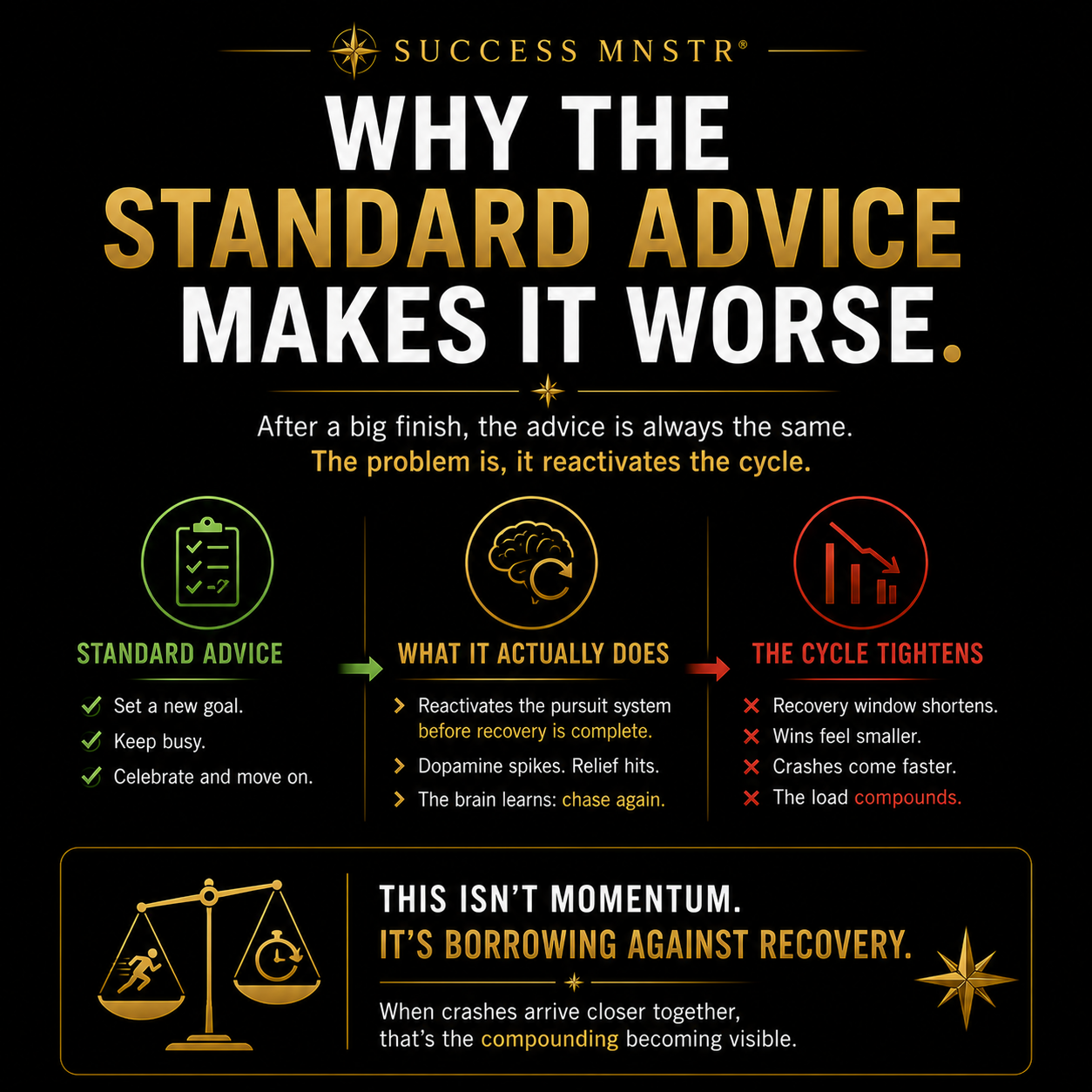
Why the standard advice makes it worse
Every piece of conventional wisdom after a big finish points in the same direction. Set a new goal. Keep busy. Celebrate and move on.
What that advice actually does is reactivate the pursuit system before the body has processed the cost of the last cycle. The dopamine reactivates. The person feels better almost immediately. And the brain learns one more time that the solution to the discomfort of finishing is to start chasing again as fast as possible.
The cycle tightens. The recovery window shortens. The wins feel smaller because the Reward Evaluation System has raised the baseline again. The crashes come faster because the allostatic load compounds with every loop that runs without a real recovery.
The people who set a new goal immediately are not building momentum. They are borrowing against a recovery they have not taken, and the interest accumulates. When you notice the crashes arriving closer together than they used to, that is the compounding becoming visible.
The window most people waste
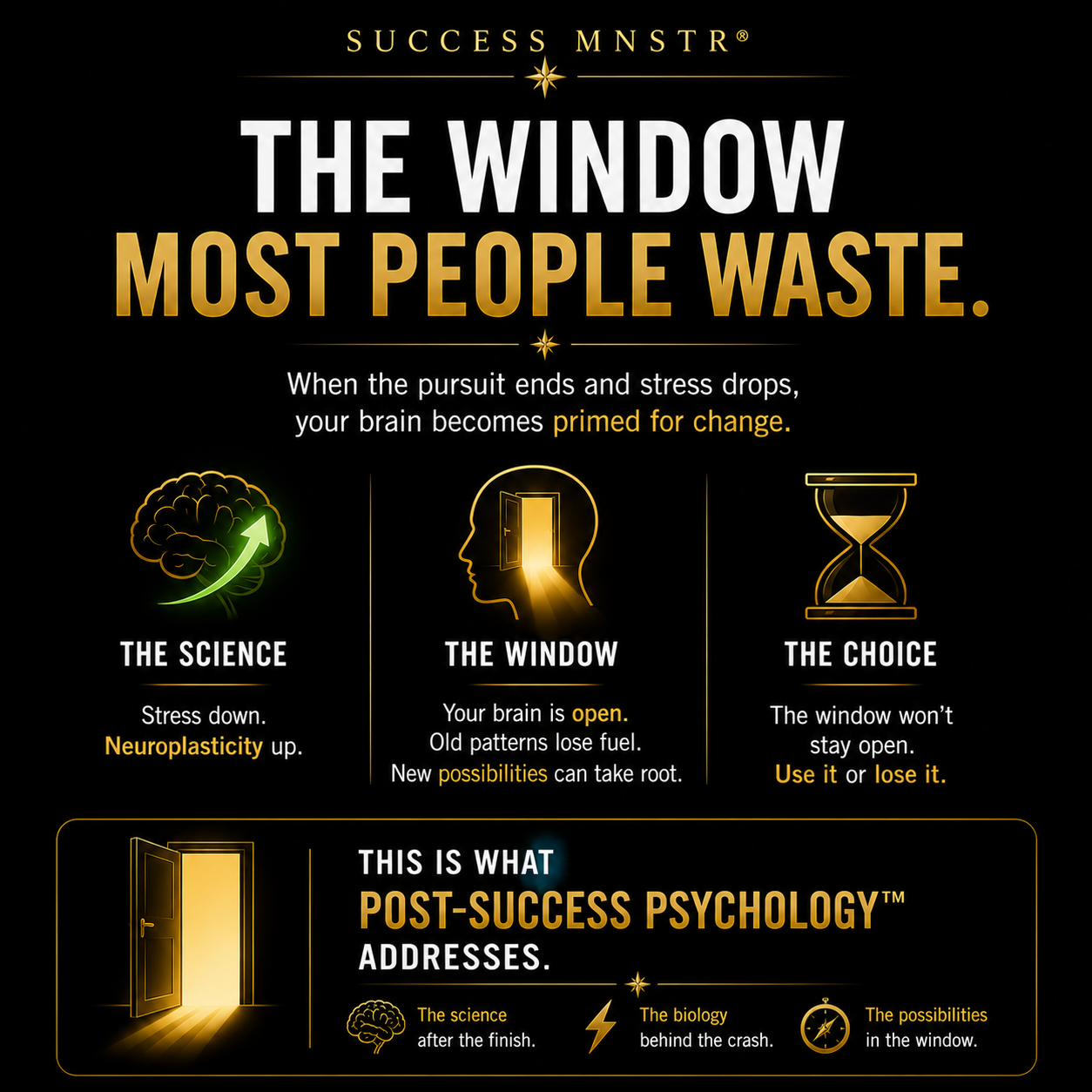
A randomized clinical trial with 332 adults published in Biological Psychiatry: Global Open Science found that cortisol reduction directly increases BDNF, the brain's primary driver of neuroplasticity and new neural pattern formation. In plain language: when the sustained pursuit ends and the stress chemistry drops, the brain's capacity to form new patterns increases.
The disorientation after a major finish is the biology shifting. The pattern that built itself around the goal is temporarily without reinforcement. That is the most neurologically open moment a person gets for change. The old structure has nothing to feed it. For the first time in months or years, the brain has room to run something different.
That window does not stay open indefinitely. The brain will find something new to organize around, with or without your input. The question is whether you use the window intentionally or let the next goal close it before you ever understood what was available to you.
This is what Post-Success Psychology™ addresses. The science of what happens after the finish line, the biological mechanism behind the crash, and what becomes possible in the window most people close before they ever use it.
The hand grip
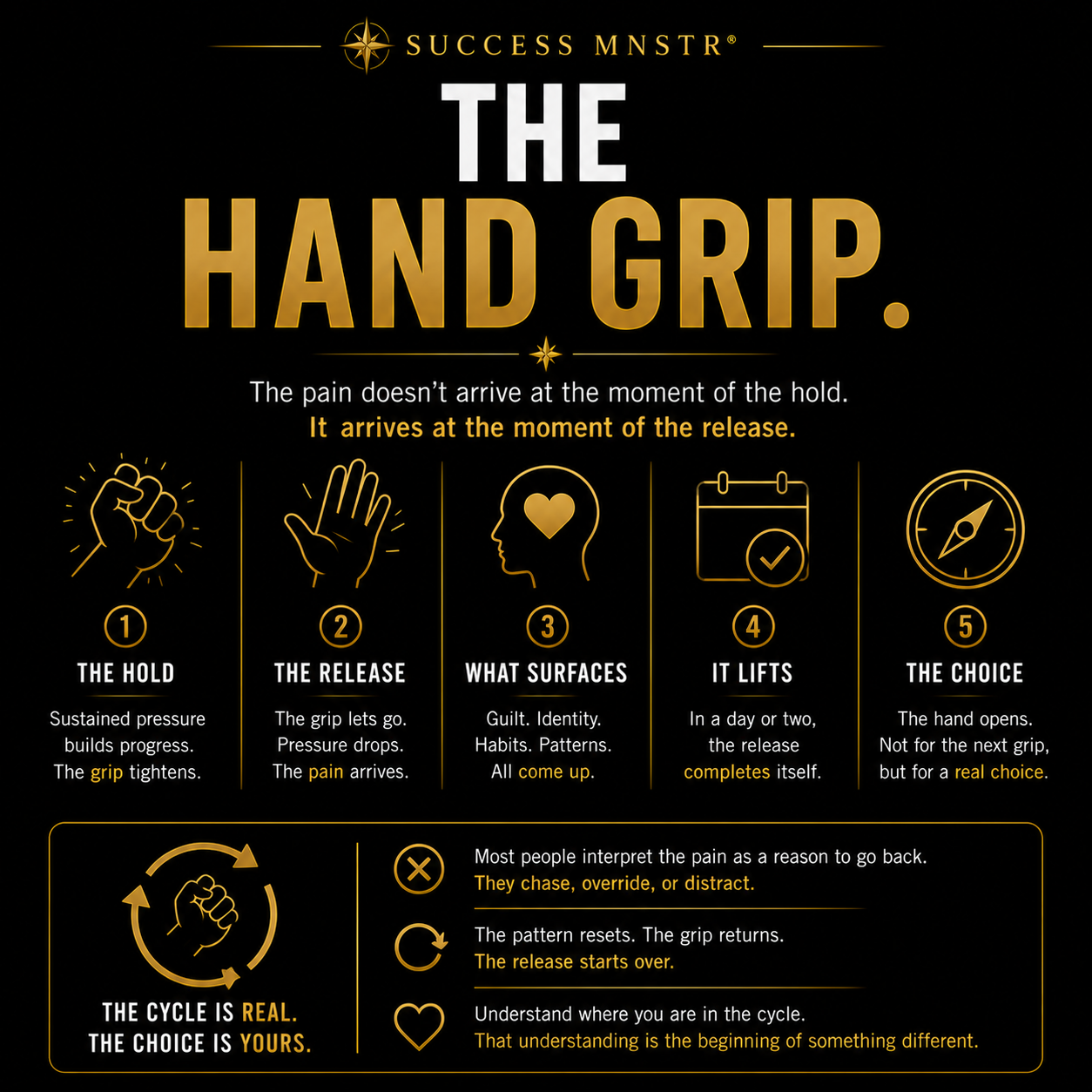
If you grip something for a long time and then let go, your hand starts to hurt. That is just what happens when sustained pressure releases. No injury required.
The crash after finishing something significant works the same way. But the hand grip goes deeper than the physical image. When someone starts releasing a pattern they have been holding onto for a long time, the pain does not always arrive at the moment of the hold. It arrives at the moment of the release. You start making better choices. Things genuinely improve. You are doing everything right. And then, unexpectedly, you feel sadness, or grief, or a heaviness you cannot explain.
That is the hand releasing. The guilt carried for years. The identity that no longer fits. The habit that felt like safety even when it was costing something real. The pattern that organized your life even when it was wearing you out. Releasing those things has a real emotional and biological cost. And most people, in the middle of it, interpret that pain as evidence that something is going wrong.
It is the opposite. The pain is the proof that the release is real. It means something is actually letting go. And in a day or two, sometimes less, it lifts. The release completes itself. The hand opens. And what comes next is not the next grip. It is the first real choice about what to hold.
Most people close that window before it can finish. They interpret the discomfort as a reason to go back, to chase something new, to override the feeling with activity. And the pattern resets. The hand grips again. The release that was almost complete has to start over.
That is the cycle. And understanding it is where the work actually begins.
As you begin to understand which part of this cycle you are in, you will find the crash starts to make sense in a way it never did before. That understanding is the beginning of something different.
Meet your Success MNSTR at SuccessMNSTRquiz.com