

Why Driven People Can't Stop Even When They Want To
Stopping feels wrong. Rest feels like falling behind. And the guilt that arrives the moment you try to slow down has nothing to do with laziness or discipline. Your brain is treating inactivity as a threat. Here is why.
You are exhausted. You know you need to stop. And yet the moment you try, something fires underneath the surface that makes stillness feel dangerous.
Maybe it shows up as guilt. That low-grade anxiety when you are not producing anything. The restlessness that turns a Saturday into a list of things you should be doing. The inability to sit through a meal without your mind reaching for what is next.
Why do I feel guilty for not being productive? Why do I feel guilty when I am not doing anything? Why can't I stop working even when I know I need to? Why does rest feel wrong even when I have earned it?
These questions appear across every psychology platform and self-help forum in almost identical language. And the answers are almost always the same. You tie your worth to your output. You were raised in an achievement culture. You need to work on your relationship with rest.
Those answers are not wrong. They are just describing the surface of something that runs much deeper. The reason stopping feels dangerous is not a belief you can simply reframe. It is a brain system doing exactly what it was designed to do. And until you understand which system is firing and why, every attempt to rest will feel like a battle you are losing on purpose.
Before you keep reading, here is what this article covers:
Why the brain treats stopping as a biological threat, not a choice
What productivity guilt actually is at the neurological level
Why rest feels unsafe even when everything in your life is going well
Why the pattern gets stronger the longer you run it
What the robot metaphor reveals about why willpower alone never fixes this
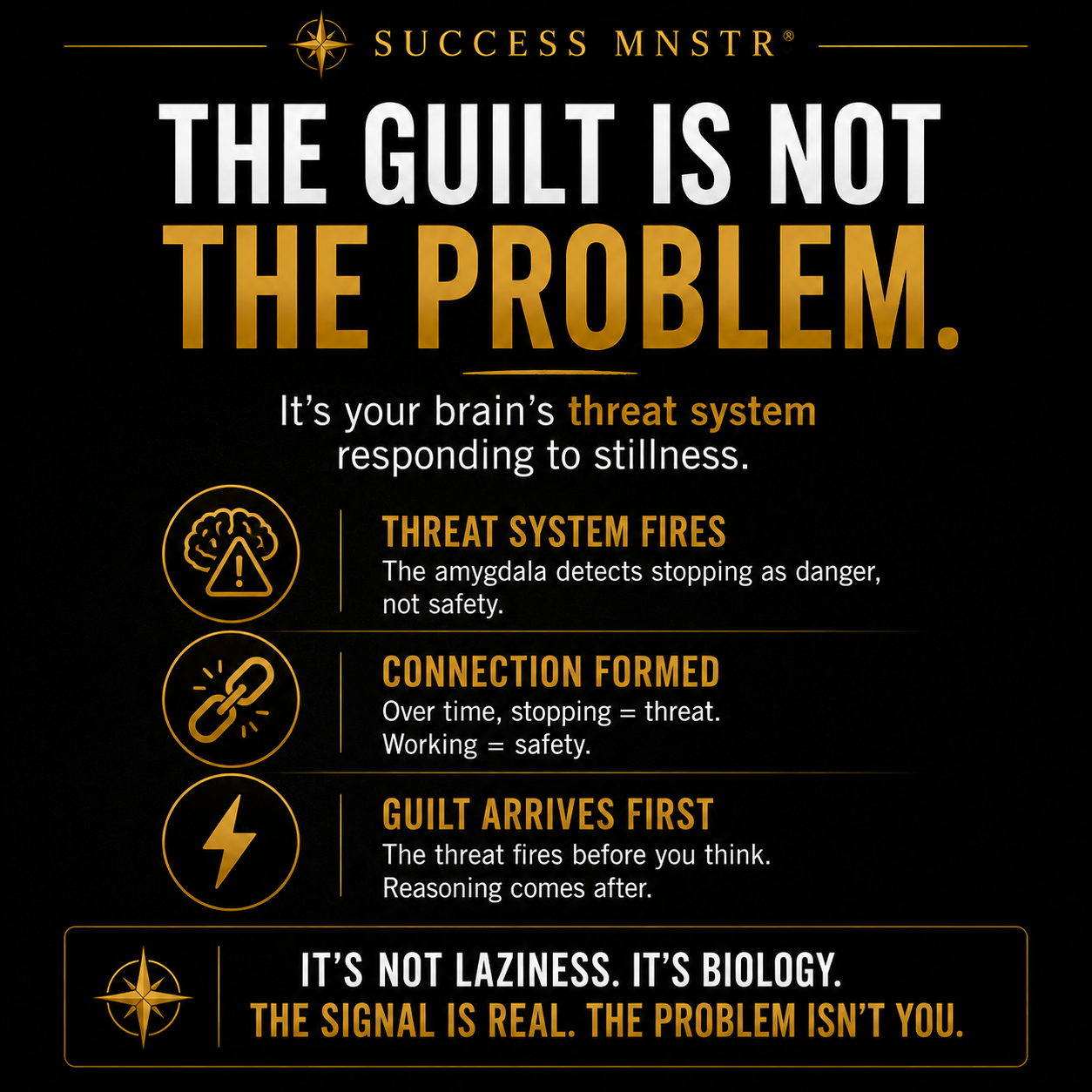
The guilt is not the problem. It is the signal.
Productivity guilt is a well-documented pattern. It is the feeling of shame, anxiety, or self-blame that arrives during rest, or even the anticipation of rest.Research confirms it is widespread, particularly among people who have built their identity around what they produce.
But most explanations stop at the psychological level. They describe what productivity guilt feels like and where it came from. They do not explain what is happening in the brain the moment you try to stop.
Here is what is actually happening.
The Threat System, anchored in the amygdala, is one of the oldest and fastest systems in the brain. Its job is to detect anything that signals danger and activate a response. For most of human history, that meant physical threats. But the amygdala does not distinguish between a physical threat and a psychological one. It responds to whatever the brain has learned to associate with risk.
For someone who has spent years running the pursuit pattern, stillness has been consistently associated with falling behind, losing ground, being less than. Every time productivity guilt fired and you responded by going back to work, the brain reinforced the connection: stopping equals threat, working equals safety. Over time that association becomes so embedded that the amygdala fires the moment you stop, before you have even had a chance to think about it. The guilt arrives first. The reasoning comes after.
This is why telling yourself it is okay to rest does not work. The amygdala is not listening to your reasoning. It has already fired.
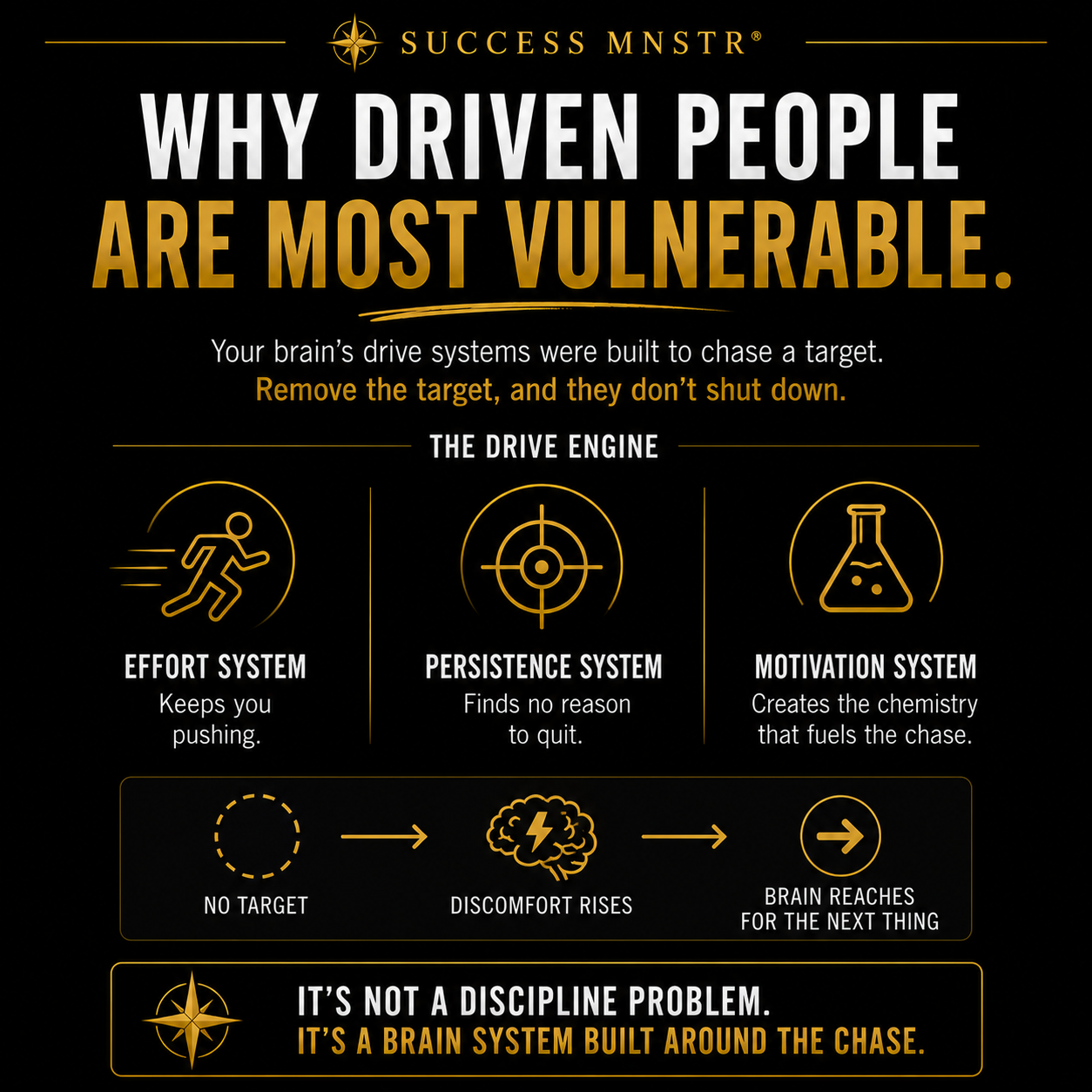
Why driven people are most vulnerable
The people most likely to experience this pattern are also the people most praised for it. The capacity to keep going, to push through exhaustion, to override the signals that tell most people to stop, is celebrated in almost every professional and achievement context. What nobody mentions is that this capacity comes with a cost.
The Drive Engine, the network of brain systems running effort, persistence, and motivation, does not have a natural off switch.The Effort System (Anterior Mid-Cingulate Cortex) keeps allocating endurance. The Persistence System (Dorsal Anterior Cingulate Cortex) keeps monitoring for reasons to quit and finding none. The Motivation System (Mesolimbic Dopamine Pathway) keeps generating the chemistry that makes the chase feel necessary.
These systems were built to keep you moving toward a target. Remove the target and they do not shut down. They generate the discomfort of no target, which feels identical to the discomfort of stopping. And the brain, which has learned that the solution to discomfort is action, reaches for the next thing.
Michael Phelps, one of the most decorated athletes in history, has spoken openly about the emptiness and suicidal thoughts he experienced after the Olympics.Research suggests that up to 90% of elite athletes experience some version of post-success blues after major competition ends. These are not people who lack discipline or self-worth. They are people whose entire neurological system was built around a target that no longer exists.
The pattern does not care how successful you are. It runs in anyone who has built their operating system around the chase.
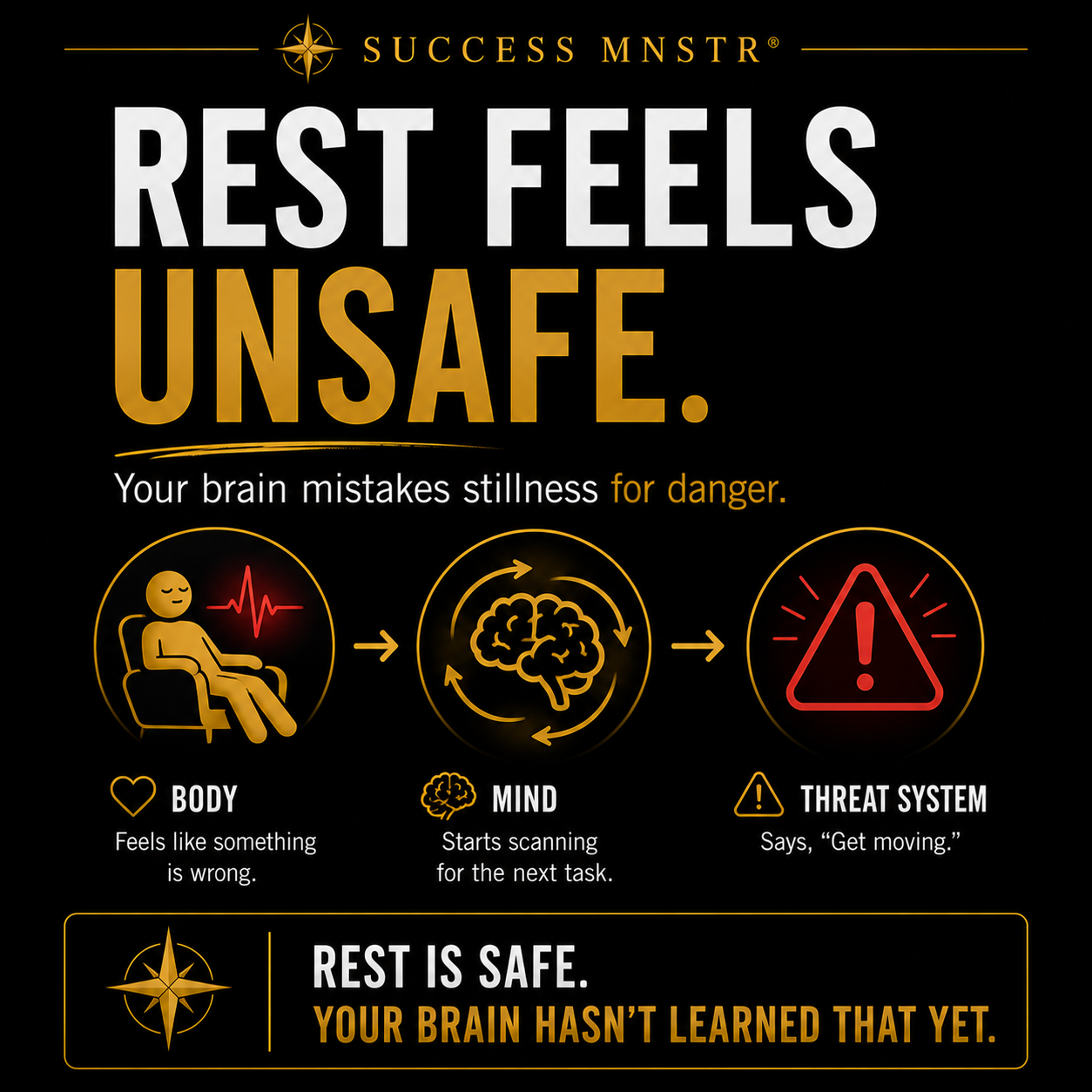
Rest feels unsafe. That is not a metaphor.
When someone who runs this pattern tries to rest, the body responds as if something is wrong. Heart rate can increase slightly. Attention becomes restless. The mind generates an inventory of unfinished things. A scanning process begins, looking for what could be done, what should be done, what a productive person would be doing right now.
This is the amygdala running a threat assessment on stillness. And because the pattern has spent years teaching the brain that stillness is dangerous, the assessment keeps returning the same result: unsafe.
The people who describe rest feeling wrong, or feeling like they do not deserve to stop, or feeling more anxious on weekends than during the week, are not describing a mindset problem. They are describing the Threat System running a program it was never taught to update.
Achievement addiction is a phrase that gets used casually but it maps to something real. The dopamine system that fires during pursuit creates a cycle not unlike other reward-driven patterns. The anticipation of progress generates chemistry. The absence of progress generates withdrawal. And the fastest way to resolve withdrawal is to start chasing again.
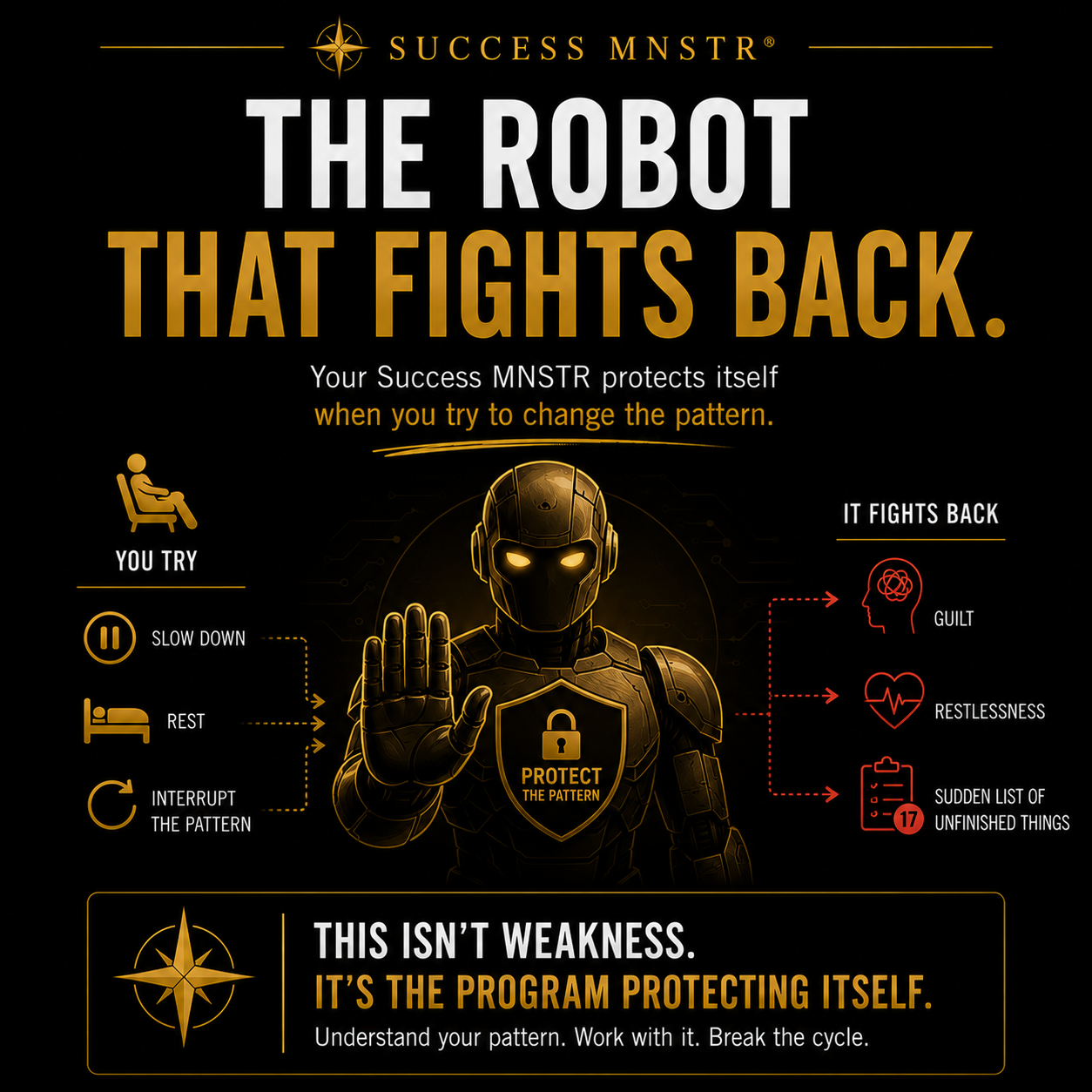
The robot that fights back
There is a reason this pattern resists the obvious fixes. It was not built to be easy to change.
Think of it like a science fiction film where the robot realizes you are trying to shut it down and starts fighting back. Your Success MNSTR does the same thing. The moment you try to slow down, to rest, to interrupt the pattern, the system generates resistance. Guilt. Restlessness. The sudden memory of seventeen things you have not done. That resistance is not weakness. It is the program protecting itself from being changed.
This is why people who understand the pattern intellectually still cannot stop running it. Knowledge does not interrupt a threat response. The amygdala does not care that you have read about this. It fires anyway. And the Control System, the only brain system that can actually override the amygdala, is the first to go offline when the pressure has been sustained for too long.
The resistance you feel when you try to rest is predictable. And because it is predictable, it can be worked with rather than against. But the approach looks different for every person, because the pattern that built the resistance is different for every person.
Understanding which pattern is running yours is the beginning of understanding why stopping feels the way it does, and what it actually needs instead of another sprint toward the next target.
As you begin to understand which version of this pattern is yours, you will find the resistance starts to make sense in a way it never did before. And a pattern that makes sense is a pattern you can finally work with.
Meet your Success MNSTR atSuccessMNSTRquiz.com