
You Finished It. Your Brain Has 30 Seconds. Here Is What to Do.
The most important moment in the cycle is not the milestone. It is the 30 seconds after it. And almost nobody uses it.

Why don't I celebrate my achievements? I never celebrate my accomplishments. How do I reward myself after finishing something? Why does celebrating feel awkward? How do I make finishing something actually feel real? I feel empty after completing a goal. How to celebrate small wins?
If you have typed any version of those into a search bar at midnight, this article is for you!
I spent four days writing eight articles. The first one took seven hours. By the time I finished the last one I could barely move. My shoulders were up around my ears. My back ached. I had not stretched, not eaten properly, not been outside enough.
My celebration was a walk to the market. A ribeye steak. Portobello mushrooms. Corn on the cob. I made it slowly, ate every single bite, and let the whole thing feel like something.
That was it. That was enough. And something in my system registered it as real in a way that a bottle of champagne never has.
I want to tell you about a client of mine. She runs an events business. She had just launched a mastermind, was creating experiences that mattered, building something from nothing. And she came to me feeling like her life was standing still. Like nothing was worth celebrating.
What she meant was: nobody was throwing her a party. No wedding. No mortgage closing. No graduation ceremony. No milestone that society had decided deserved a room full of people and a cake.
And without the ceremony, the milestone did not feel real. So she kept moving. Kept building. Kept waiting for something big enough to finally count.
I recognized that pattern immediately. Because I lived it for years.
Here is what I now understand about why that pattern runs so deep.
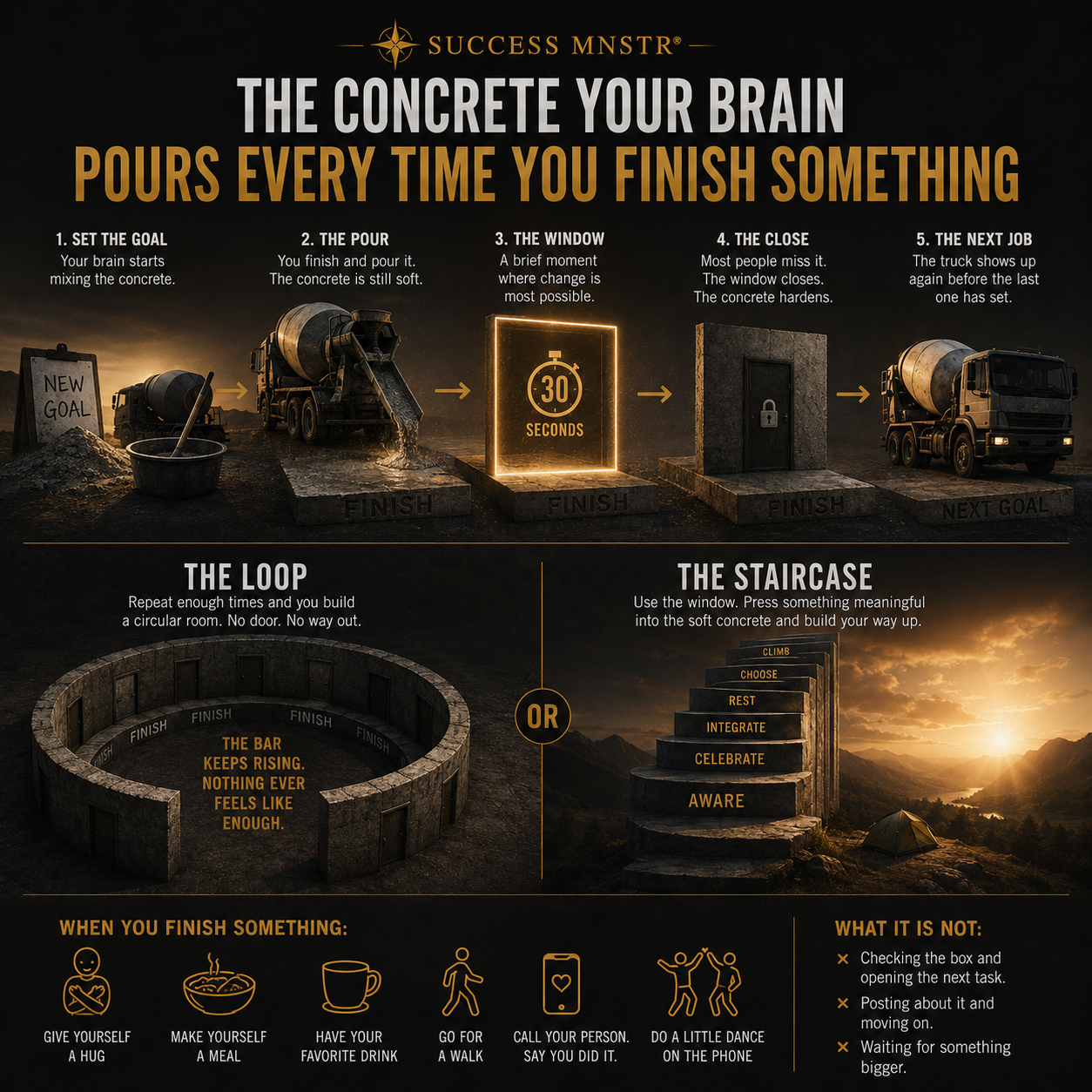
The concrete your brain pours every time you finish something
Every time you set a new goal, your brain starts mixing the concrete. It runs the chemistry, builds the anticipation, keeps you oriented toward the pour. When you finally finish and pour it, there is a brief moment where it is still soft. Neuroscientists call this the neuroplasticity window. Whatever gets pressed into that soft concrete in that moment hardens and stays. The brain does not care if what you pressed in was good for you or bad for you. It just learned that this is what finishing feels like. And it will repeat it every single time.
Most people do not even notice the concrete is still soft. The next target goes on the board and the brain immediately starts mixing the next batch. The window closes. The wall hardens with nothing useful pressed into it. And the truck pulls up to the next job before the last one has even set.
Do that enough times and the brain builds a circular room out of those walls. Every finish line becomes the starting line of the next chase. No door. No way out. The bar keeps rising automatically. What felt like a big deal last month barely registers today. What you worked a year for feels like a Tuesday by the time you get there. Every milestone recalibrates what the next one needs to feel the same thing.
The pattern is not a character flaw. It is a loop the brain built because nobody ever showed it another way.
Your brain does not change through thinking about something. It changes through experiencing something. Research on brain plasticity confirms that behavioral experience is the most potent driver of how the brain rewires itself — more than insight, more than reflection, more than any amount of gratitude practice. What that means in plain language is that the celebration has to be something your body actually does. Something with its own moment and its own shape. Something sensory enough that the brain registers it as real and files it as: this chapter is closed and it mattered.
The celebration is the staircase. It is the one thing that breaks the circular pattern. Press it into the concrete while it is still soft and instead of building another wall in the same circular room, you build yourself a way up and out. Up to a place where you can breathe. Where you can pitch a tent, rest, and choose your next climb when you are ready. Not stopping. Not quitting. Just landing before the next ascent.
It does not need money, an audience, or a milestone society decided was big enough to count. It just needs to be real. And it needs to happen before the next thing begins.
When you finish something, stand up and give yourself a hug. Go make yourself a meal. Have your favorite drink. Go for a walk. Call your favorite person and say, guess what, I did it. Do a little dance with each other on either end of the phone.
What it is not is checking the box and immediately opening the next task. Posting about it and moving on before the moment has even landed. Waiting for something bigger before you allow yourself to feel this one.
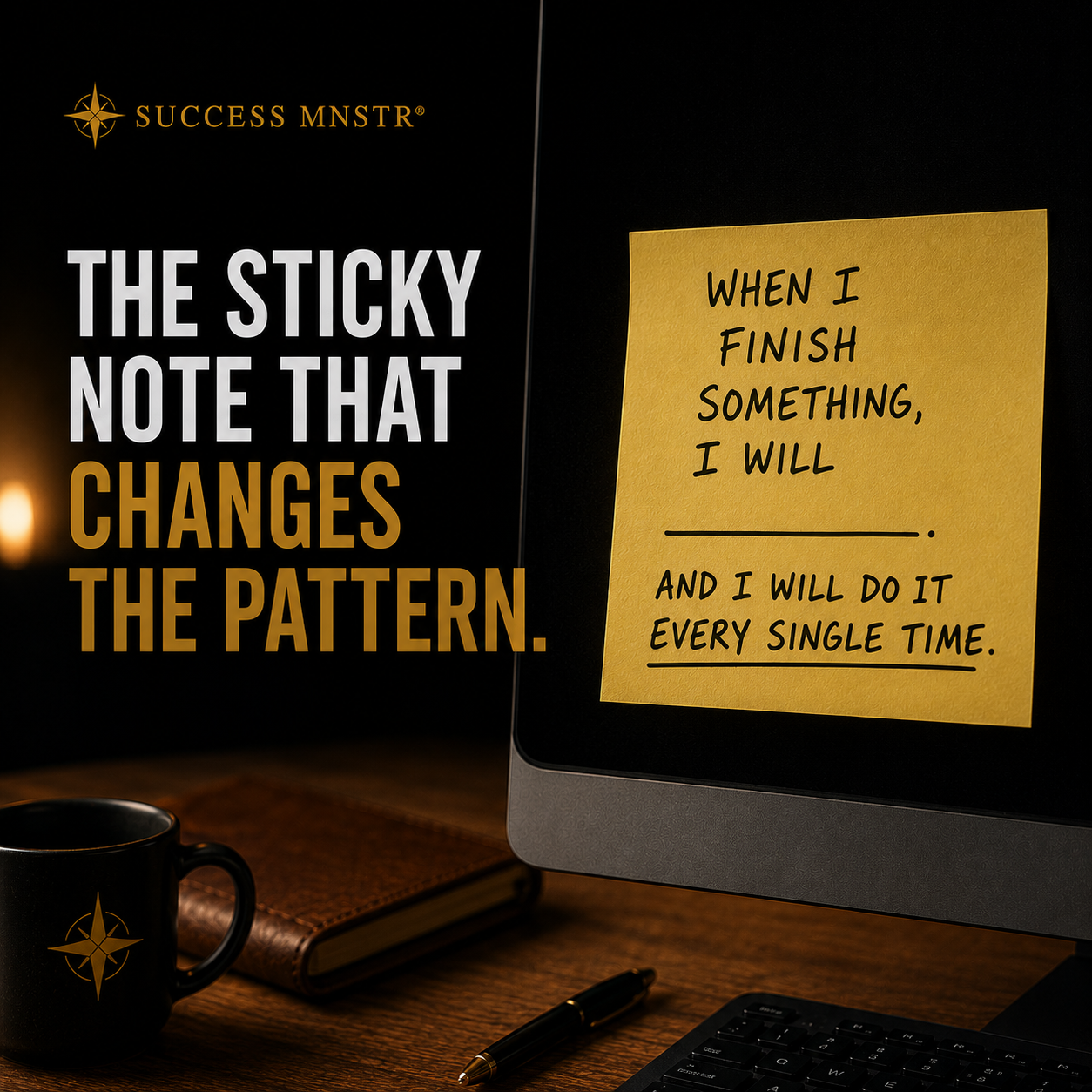
The sticky note that changes the pattern
I want you to do one thing after you finish reading this.
Write down your version. One sentence. Put it on a sticky note on your computer or your bathroom mirror or somewhere you will see it every single time you finish something.
When I finish something, I will ______. And I will do it every single time.
Fill in the blank with something small. Easy. Inexpensive. Something you can repeat after every finish line not just the big ones. The email sent. The meeting ended. The article written. The workout done. The difficult conversation had.
Every one of those is a finish line. Every one of them deserves the 30 seconds it takes to tell your brain it happened.
The reason to start small is not because the small milestones do not matter. It is because the brain learns the pattern from repetition. Celebrate the small ones consistently and celebrating the big ones starts to feel natural instead of awkward or undeserved. Skip the small ones consistently and the big ones land flat no matter how hard you worked for them.
My client did not need a bigger milestone. She did not need someone else to validate what she had built. She needed a sticky note and permission to treat the small finish lines as real ones. To make her own version of the ribeye before waiting for the world to hand her a ceremony.
The walk to the market taught my system something the four days of writing alone never could. That finishing something is worth stopping for. That the pause between one thing and the next is not wasted time. That I am worth the ribeye.
You are worth it too. Whatever your version of the ribeye is.
The pattern that has been running your cycle was never taught to build a staircase. It only knows how to pour the next wall. Every time you skip the celebration window you hand it the same batch of concrete and it builds the same circular room one wall higher. Every time you use the window you press something different into the wet concrete before it sets. That is how the room gets a door. That is how you build your way to the place where you can breathe.
Thirty seconds. One sentence on a sticky note. Your version of the meal, the walk, the dance on the phone.
That is where the cycle starts to change.
Meet your Success MNSTR at SuccessMNSTRquiz.com